- Home
- Sourcing guides
- Soft PVC, silicone, acrylic, embroidered or 3D-printed: choosing a charm material
Soft PVC, silicone, acrylic, embroidered or 3D-printed: choosing a charm material
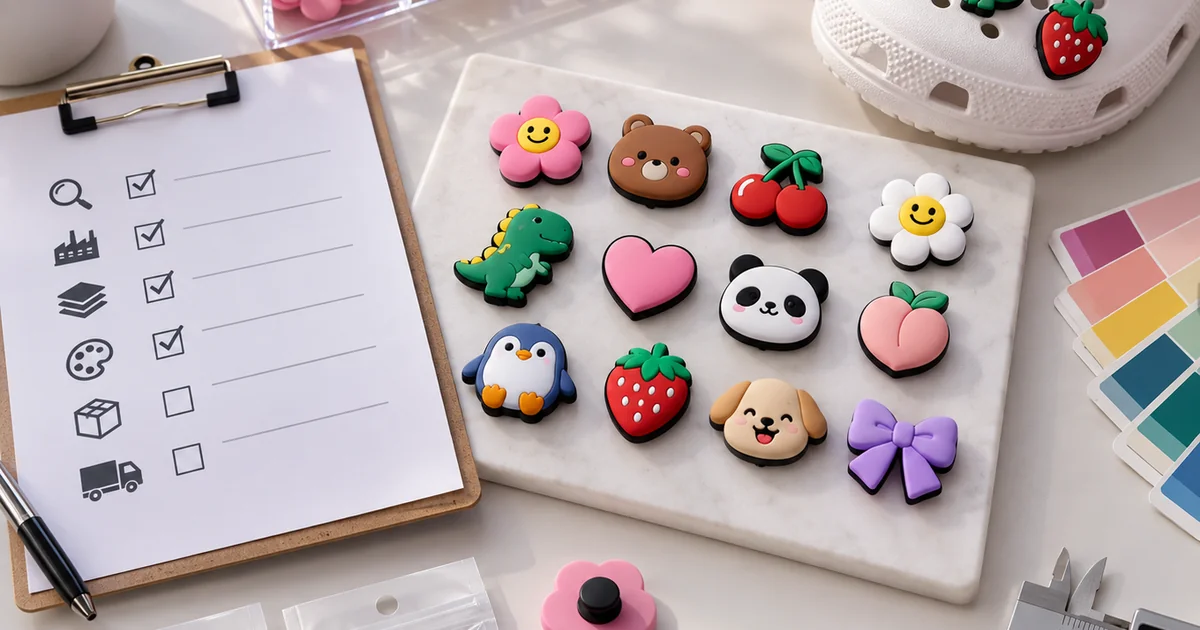
For charms that go on clog-style shoes, soft PVC is the usual choice: it is soft, bends with the shoe, holds bold colors and costs little per piece at a few hundred pieces per design. Silicone feels smoother and stands more heat but usually costs more to start; acrylic and 3D printing need no mold and suit very small runs; embroidery gives a fabric look that suits bags and clothing better than shoes. We make soft PVC only, so this guide describes the other materials as they are generally made in the industry.
The five materials at a glance
| Material | Feel | Detail | On a shoe | Minimum order | Price per piece | Lead time |
|---|---|---|---|---|---|---|
| Soft PVC | Soft, rubbery, flexible | Bold color areas with raised outlines; fine text is UV-printed | Bends with the shoe, water-resistant, wipes clean | From 100 pieces per design with us | $0.30 to $0.10 with us, plus a mold per design | Sample in about 3 business days, bulk in 7–10 days under 5,000 pieces |
| Silicone | Softer and smoother, often matte | Clean shapes; fewer fine color separations | Flexible, stands more heat, can pick up dust | Usually higher than soft PVC | Usually higher than soft PVC | Longer to start, because the molds take longer |
| Acrylic | Hard and flat | Printed, so photos, gradients and small text are easy | Rigid; edges and print can scratch | Low, no mold needed | Moderate | Fast to start |
| Embroidered | Fabric, with a stitched texture | Limited by thread width; small text is hard | Absorbs water and dirt, can fray | Low to moderate | Moderate | Moderate |
| 3D-printed | Hard or semi-rigid, depending on the resin | Full 3D shapes; color is usually painted or limited | Depends on the resin and finish | Very low, even single pieces | High, and it stays high at volume | Fast for a few pieces, slow for thousands |
The table compares typical charms at around 25 to 35 mm. For the other materials, minimums, prices and lead times vary a lot between factories, so check them with the supplier you use.
Soft PVC
Soft PVC is a flexible plastic applied as a liquid and cured by heat. In drip molding, each color is a separate layer poured into a mold, which gives the glossy color blocks and raised outlines that most shoe charms have. It takes glitter and glow-in-the-dark pigment mixed into a color layer, and it bends instead of cracking when a shoe flexes. See how soft PVC charms are made.
Its limits come from the liquid: very thin lines and small gaps cannot hold PVC, gradients become two or three color steps, and every extra color is an extra layer. Fine text and gradients can be UV-printed on top. Soft PVC should be kept away from high heat, such as a car dashboard in summer or a clothes dryer.
The main cost to start is the mold, $30–80 per design, which is why our prices and minimums are set per design; how the mold fee works explains it. For charms that children will wear, we use phthalate-free soft PVC. The materials page describes what we use.
Silicone
Silicone charms are usually pressed or injected into heated molds. They feel softer and smoother than PVC, often with a matte surface, and silicone stands up to heat better. It is a good choice when the feel matters most, or when a charm also has to survive heat. The usual drawbacks are a higher setup cost and minimum order, fewer crisp color separations than drip-molded PVC, and a surface that can pick up dust and lint.
Acrylic
Acrylic charms are cut from a clear or colored sheet, usually by laser, and printed on. Because the image is printed, they reproduce photos, gradients and small text that a mold cannot. With no mold, they are quick and cheap to start in small quantities. They are rigid, so they do not bend with a shoe, and the edges and print can scratch with wear. They suit keychains, bag tags and display pieces more than footwear.
Embroidered
Embroidered charms are stitched designs on fabric, finished like small patches, with a backing attached. They give a textile, handmade look that matches bags, hats and clothing. Detail is limited by the width of the thread, so small text and fine lines are hard. On shoes they absorb water and dirt and can fray at the edges, so they are less common for footwear.
3D-printed
3D-printed charms are built up layer by layer from resin or plastic, with no mold. That makes them useful for prototypes, single pieces and shapes that are fully three-dimensional. Each piece takes printing time and often hand finishing or painting, so the price per piece stays high at volume. For a range of hundreds or thousands of charms, a molded material is usually far cheaper.
Which to choose
- Charms for clog-style shoes, in hundreds or thousands per design: soft PVC. It is the material these charms are usually made in, it bends with the shoe, and the price per piece falls quickly with quantity. See our price breakdown for worked examples.
- The softest feel, or charms that must stand heat: silicone, if the higher setup cost fits your budget.
- Photo-quality images or many designs in very small quantities: acrylic.
- A fabric look for bags or clothing: embroidery.
- A prototype or a handful of pieces before you commit to a mold: 3D printing. If you already know the design, a soft PVC sample from the real mold shows exactly what bulk production will look like; see how sampling works.
Whatever the material, charms that go on clog-style shoes need a backing that fits the holes. Our clog-hole fit page explains how the standard button backing works.
Common questions
Is soft PVC the same as rubber?
No. Soft PVC is a plastic that feels rubbery once cured. It is flexible and water-resistant, which is why it is used for most shoe charms.
Is PVC or silicone safer for children?
What matters for children's products is the exact material and testing for the market where they are sold, not the name of the material. For charms that children will wear, we use phthalate-free soft PVC. Our guide on safety rules for children's charms explains the United States, EU and UK requirements and who is responsible for testing.
Do you make silicone, acrylic, embroidered or 3D-printed charms?
No. We make soft PVC charms only. We do not make metal charms, hard enamel or cast pieces either.
Can soft PVC show my small text or gradient?
Text that is too small to mold and gradients are UV-printed on top of the molded charm, which is priced separately. Larger text and simple shapes can be molded in.
Which material lasts longest on a shoe?
Soft PVC and silicone both flex with the shoe and handle water. Acrylic can scratch and does not bend, and embroidery absorbs water and dirt. Keep any charm away from high heat.
More answers are on the FAQ page, and the budget calculator on the prices page estimates the cost of a soft PVC order. Send your artwork and within one working day we send a proof sheet showing how the charm will look, its size in millimetres, the number of colors and the backing position. It is free and you do not need to place an order first. Send your artwork through the quote form, with the number of designs and the quantity of each.