- Home
- Sourcing guides
- Are custom shoe charms safe for kids? US, EU and UK rules
Are custom shoe charms safe for kids? US, EU and UK rules
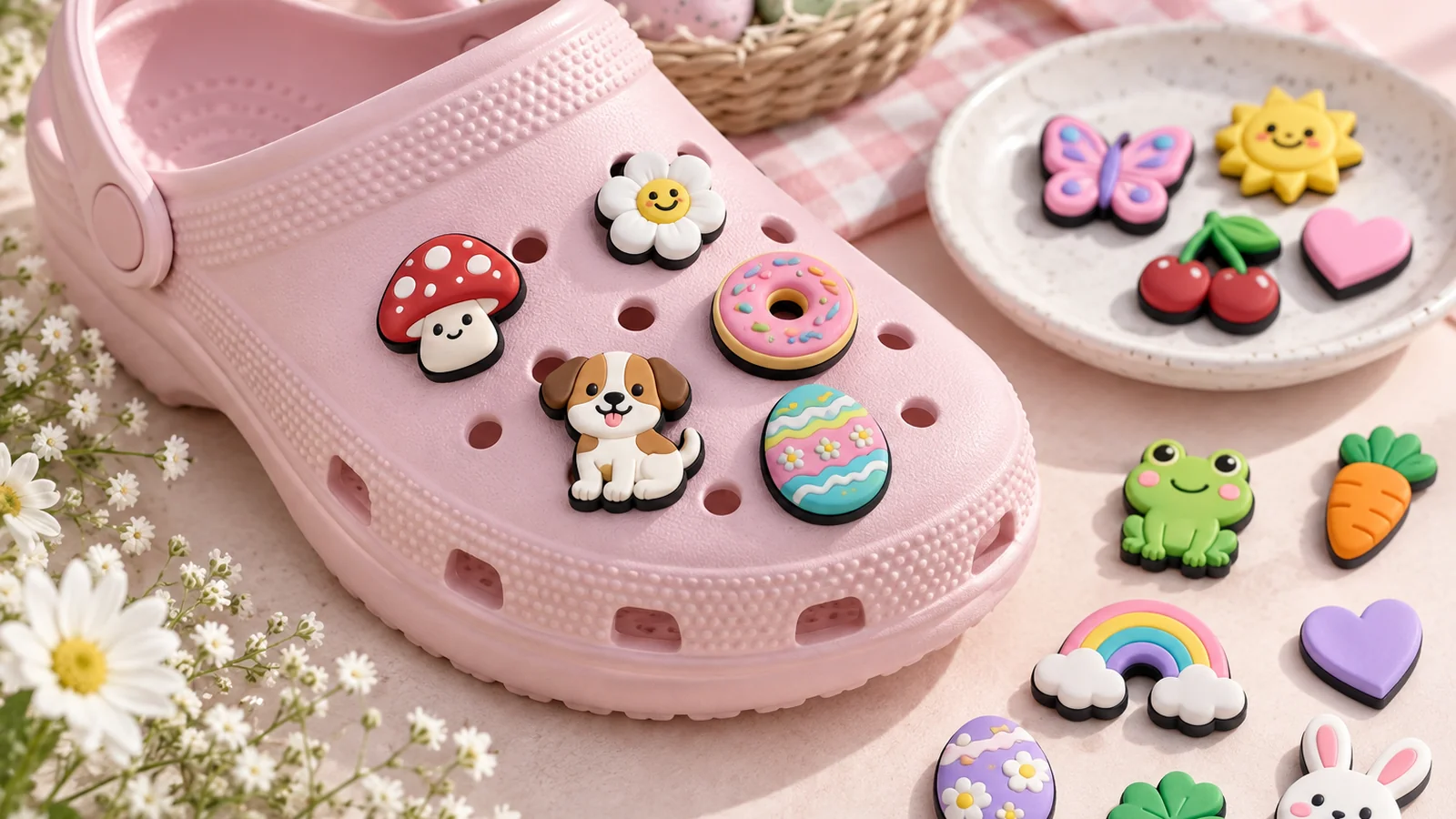
Soft PVC shoe charms can be sold for children when the material and the finished charms meet the rules of the market they are sold in. In the United States, a children's product must have no more than 100 ppm of lead in any accessible part, a children's toy must have no more than 0.1% of each of eight phthalates, and compliance must be shown by tests at a CPSC-accepted lab and certified by the US importer. For charms that children will wear, we use phthalate-free soft PVC; this guide explains the rest of the rules and who is responsible for each.
First question: is your charm a children's product?
US law defines a children's product as a consumer product designed or intended primarily for children 12 years of age or younger. The U.S. Consumer Product Safety Commission (CPSC) decides this from four things: what the maker says about intended use, including labels; how the product is packaged, displayed and advertised; whether consumers commonly see it as meant for children; and the CPSC's age determination guidelines.
For charms, that usually comes down to the designs and the sales channel. Cartoon animals sold for kids' clogs, in a children's store or on a page aimed at parents, are likely to be treated as children's products. A range sold for adults is not, even if children sometimes wear it.
United States: the rules that apply to children's charms
| Rule | What it requires | Applies to |
|---|---|---|
| Total lead (CPSIA section 101) | No more than 100 ppm lead in any accessible component | All children's products |
| Lead in paint and coatings (16 CFR part 1303) | No more than 90 ppm (0.009%) lead in paint and similar surface coatings | Painted or coated parts of children's products |
| Phthalates (16 CFR part 1307) | No more than 0.1% of each of DEHP, DBP, BBP, DINP, DIBP, DPENP, DHEXP and DCHP in an accessible plasticized component | Children's toys and child care articles |
| Small parts (16 CFR parts 1500 and 1501) | No small parts in products intended for children under 3; a choking hazard warning on toys and games with small parts for children aged 3 to under 6 | Toys and articles for young children |
| Tracking labels (CPSIA section 103) | Permanent marks on the product and its packaging, to the extent practicable, with the maker or importer, place and date of production, and batch details | All children's products |
| Testing and certificate (CPSA section 14) | Tests at a third-party, CPSC-accepted laboratory, and a written Children's Product Certificate (CPC) | All children's products |
The phthalate rule covers toys, not every children's product. CPSC defines a children's toy as a product for a child 12 or younger to use when playing, and its phthalate guidance says shoes are not children's toys. A charm, though, can be collected, swapped and played with, so whether a charm range counts as a toy depends on how it is designed and sold. We use phthalate-free soft PVC for children's charms whichever way your range is classed, and your lab can tell you whether to test and certify the charms to part 1307.
Small parts are about the age you sell to. A part is small if it fits entirely into the CPSC's small parts test cylinder, and many charms do. Products intended for children under 3 must not contain small parts, although the rule exempts children's clothing and accessories such as shoe lace holders and buttons. Toys and games for children aged 3 to under 6 that contain small parts must carry this warning:
WARNING: CHOKING HAZARD – Small parts. Not for children under 3 yrs.
Whether a charm on a shoe counts as an accessory or a toy is again a question for your lab. If the charms are not meant for children under 3, make that clear in how you label and sell them.
The importer issues the certificate, not the factory. Under US law, the domestic manufacturer or the importer certifies a children's product. For charms made in China, that is the US importer, which is usually you or your brand. The CPC lists the product, each rule it is certified to, the importer, the person who keeps the test records, the date and place of manufacture, the date and place of testing, and the lab. From July 8, 2026, importers of most regulated consumer products must also file certificate data electronically with U.S. Customs and Border Protection when the goods are imported.
In June 2026 the CPSC reviewed the lead limits for children's products and decided not to change them, so the 100 ppm and 90 ppm limits above are current.
Who does what
| Step | The buyer or importer | Our factory |
|---|---|---|
| Age and product type | Decides the age group and whether the charms are sold as toys | Needs to know when the charms are for children, so we quote and produce them in phthalate-free soft PVC |
| Testing | Chooses which tests to run and pays for them | Can arrange tests at an accredited third-party lab on your pre-production samples; the fee is quoted separately |
| Certificate | Issues the CPC and, from July 8, 2026, files it electronically with customs | Provides the production details the certificate asks for, such as date and place of manufacture |
| Labels and packaging | Supplies the tracking information and any warnings | Prints the warnings and tracking text you supply on branded backing cards; a different batch number on every card is quoted separately |
The materials page describes the soft PVC we use, and how sampling works explains the pre-production samples that testing is done on.
European Union
Under the REACH regulation, four phthalates (DEHP, DBP, BBP and DIBP) are restricted to below 0.1% by weight of the plasticised material, individually or combined, in all articles placed on the EU market since 7 July 2020, not only in toys. Three more (DINP, DIDP and DNOP) are restricted in toys and childcare articles that children can put in their mouths.
If the charms are toys, meaning products designed or intended for use in play by children under 14, they must meet the Toy Safety Directive 2009/48/EC and carry the CE marking. The usual way to show this is testing to the EN 71 series of harmonised standards, such as EN 71-1 (mechanical and physical properties), EN 71-2 (flammability) and EN 71-3 (migration of certain elements). A new Toy Safety Regulation, (EU) 2025/2509, replaces the directive and applies from 1 August 2030. Charms that are not toys fall under the General Product Safety Regulation (EU) 2023/988, which has applied since 13 December 2024.
United Kingdom
In Great Britain, toys for use in play by children under 14 must meet the Toys (Safety) Regulations 2011. Toys can carry either the CE or the UKCA marking, and the government has extended recognition of the CE marking in Great Britain indefinitely. Northern Ireland follows the EU rules under the Windsor Framework. UK REACH keeps the same phthalate restrictions as entries 51 and 52 of the EU list.
A checklist before you order
- Decide the age group and whether the charms will be sold as toys.
- Tell us at the quote stage that the charms are for children.
- Ask a lab which tests apply in each country you sell to, and budget for them.
- Prepare the tracking label text and any warnings for the packaging.
Our price breakdown lists the other parts of the price. If you are still choosing a material, our guide to charm materials compares soft PVC with silicone, acrylic, embroidered and 3D-printed charms.
Common questions
Are your charms CPSIA certified?
A Children's Product Certificate belongs to a specific product and is issued by the US importer, based on tests of that product at a CPSC-accepted lab. We do not put certification badges on our site. We can arrange the tests on your pre-production samples, with the fee quoted separately.
If the PVC is phthalate-free, is that enough?
No. Phthalates are one requirement. A children's product also has to meet the lead limits, the small parts rules for its age group and the labeling rules, and in the United States it needs third-party testing and a certificate.
Do charms for adults need this testing?
The US children's product rules apply when a product is designed or intended primarily for children 12 or younger. In the EU, the REACH phthalate limit for articles applies to adult charms too.
Can you make designs of characters children like?
Only designs you own or are licensed to use. We do not sell or show customer designs. More answers are on the FAQ page, and the budget calculator on the prices page estimates the cost of an order. Send your artwork and within one working day we send a proof sheet showing how the charm will look, its size in millimetres, the number of colors and the backing position. It is free and you do not need to place an order first. Send your artwork through the quote form, with the number of designs and the quantity of each.
Sources
- CPSC, Children's products (definition and the four factors)
- CPSC, Total lead content FAQ (100 ppm and 90 ppm)
- Federal Register, Notice of Commission determination regarding technological feasibility of lead content reduction, June 24, 2026
- CPSC, Phthalates business guidance and phthalates FAQ (eight phthalates, toys and child care articles, shoes)
- CPSC, Small parts for toys and children's products, and Child Safety Protection Act fact sheet (warning text)
- CPSC, Tracking labels
- CPSC, Children's Product Certificate (who certifies, required contents, eFiling from July 8, 2026)
- Commission Regulation (EU) 2018/2005, amending REACH Annex XVII entry 51
- Directive 2009/48/EC on the safety of toys, and Commission Implementing Decision (EU) 2023/740 on harmonised standards for toys
- European Commission, Toy safety (Toy Safety Regulation (EU) 2025/2509)
- Regulation (EU) 2023/988 on general product safety
- UK government, Toys (Safety) Regulations 2011: Great Britain, and UK REACH Annex XVII
This guide summarizes official sources as of October 2026 and is not legal advice. Confirm the requirements for your product with your importer, customs broker or testing lab.