- Home
- Sourcing guides
- Southeast Asia Charms: A Two-Calendar Sourcing Map for Retail Buyers
Southeast Asia Charms: A Two-Calendar Sourcing Map for Retail Buyers
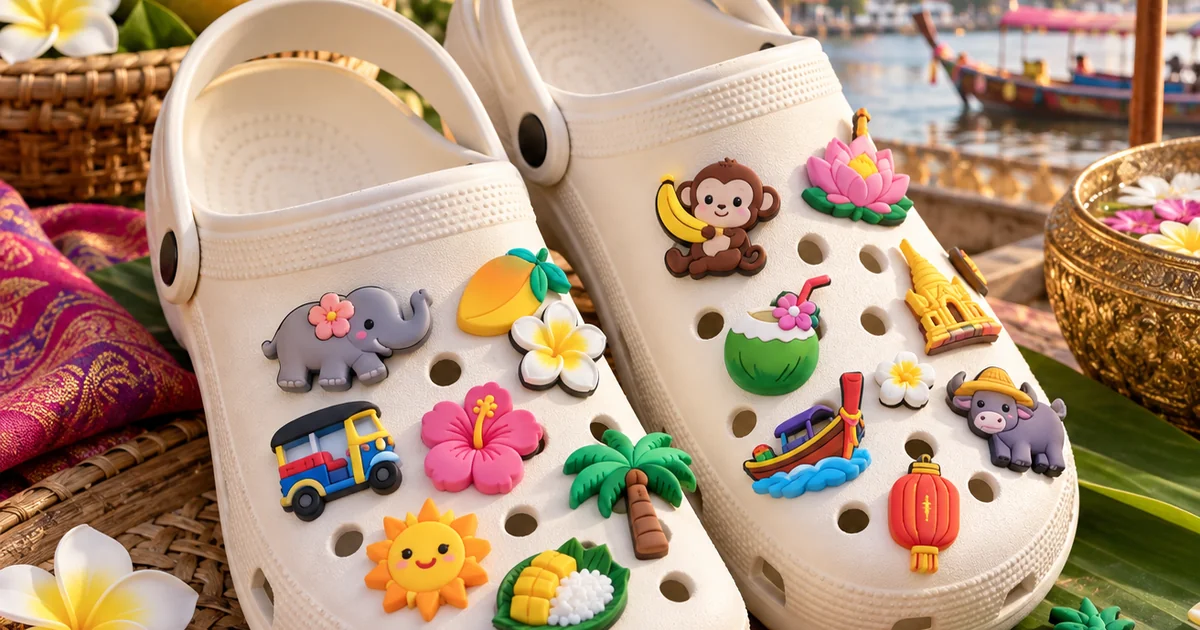
Most charm buyers run one annual rhythm: they plan around a Western calendar of Valentine's, Easter, Halloween and Christmas, and they import that rhythm everywhere they sell. In Southeast Asia that single calendar quietly loses them two seasons a year. The region runs on different clocks — two school calendars that start months apart, four mega-sale peaks stacked into the final quarter, and a livestream retail culture that rewards suppliers who can show a product close-up and ship new versions fast.
None of that is speculative. The regional evidence is consistent, and it points to one conclusion: Southeast Asia is not a secondary market that inherits Europe's leftover seasonal stock. It is a market with its own dates, its own buying behaviour and its own display logic — and it rewards buyers who plan for it deliberately. This piece maps the year the way the region actually experiences it.
1. Two school calendars, two order windows
The single most important fact about Southeast Asian back-to-school is that there is no single back-to-school. Singapore's school year begins in early January — the Ministry of Education has confirmed a 2 January start for the 2026 school year. The Philippines moves in the opposite direction: public schools are back on 8 June for the 2026/27 year. Indonesia staggers its starts across provinces from July, with the exact weeks set by local calendars.
Three markets, three start dates, three order windows. A buyer who sources once in spring for "back to school" serves exactly one of them. Done properly, the same charm programme runs three times a year: stock confirmed for Singapore in November and December, for the Philippines from March through May, and for Indonesia and Malaysia from April through June. Same moulds, same series rules, three separate drops — the seasonal sourcing calendar covers how those windows sit against the rest of the year.
2. What the livestream market rewards
The regional evidence on how Southeast Asian shoppers actually buy fashion is unusually specific. Shopee's research on female fashion consumers across Southeast Asia and Taiwan found that shoppers will pay more for quality, brands and special-occasion pieces; that they weigh fast delivery and accurate product imagery heavily; and that three quarters are interested in fashion livestreams. TikTok's APAC trend research adds the production side: in Indonesia, eighty percent of users prefer mixed image-and-video content, and the winning cadence is micro-trends tested in fast multiple versions with live comment feedback.
Translated into product requirements, that evidence dictates a specific kind of charm:
- High-visibility silhouettes. A shape that reads in one glance on a phone screen, before the streamer says a word about it.
- Close-up-proof texture. Moulded soft PVC holds its detail under a macro lens — thick colour zones and bold contours survive a two-second close-up that would flatten a printed sticker.
- Fast series refresh. Micro-trends decay quickly; the model that works is a low-tooling-cost library refreshed in colourways and small motif edits, not a single hero mould re-ordered for a year.
A 30 mm wearable size with bold, separated colour zones is the exact profile this market rewards — and it is, not coincidentally, the profile that survives a school bag.
3. The final-quarter stack: 9.9 through 12.12
Where a Western buyer sees the fourth quarter as Christmas season, a Southeast Asian buyer sees a relay of platform mega-sales: 9.9 opens the sequence in September, 10.10 and 11.11 follow at monthly intervals, and 12.12 closes the year. The evidence-based position on these dates is that they are mechanisms, not themes: the correct response is not a "12.12 charm" but gift-ready sets, clear price architecture within your range, and a replenishment plan that lets the hero design be re-ordered mid-campaign.
Stacked on top of the relay is the region's own Christmas behaviour, and it runs late. Shopee's Christmas research found that more than a third of shoppers in the region only start looking for gifts two to four weeks before the festival, with Vietnam skewing to the final week. For a charm buyer that late window is an argument, not a warning: the region tolerates — actively rewards — a fast-turn core range held for late November confirmation, in a way the European Christmas calendar, with its country-specific autumn buying peaks, does not. Fashion is the number-one gifting category across Singapore, Malaysia, Taiwan, Vietnam and the Philippines in the same research, which means the demand is there; it simply arrives on a later schedule than a Northern Hemisphere buyer expects.
4. Lunar New Year, in regional colour
Lunar New Year in 2027 falls on 6 February — inside the Singapore January school window, which is why the regional month maps show the two peaks running together. The regional read on motifs matters here: the red-and-gold base palette travels, but Southeast Asia's multicolour tolerance means the gifting range can carry broader palettes than a single-market programme. The design discipline is to keep the motif vocabulary on red packets, travel and family identity marks and away from zodiac character IP, which strands inventory the moment the year turns. A zodiac-free red-and-gold plus regional-colour range serves the whole festival quarter and clears into the March reload.
5. What this means for the product itself
The regional evidence converges on a product brief that is noticeably different from the European one:
- Colour-forward, high-contrast series. Screen-first retail rewards palettes that photograph as a family — the quiet backbone of a livestream wall.
- Sets and backing cards, not loose charms. Gift-ready formats carry the mega-sale relay; the printed card does the storytelling that a streamer has three seconds to do.
- Modular, low-commitment libraries. Short micro-trend half-lives argue for series structures that refresh without new tooling — one hero, a core of three to five, one or two tests, re-coloured season to season.
- Moulded depth over printed surface. Quality judgement happens at close-up range in this market; moulded soft PVC with a 30 mm wearable size and physical colour-card approvals is built for exactly that scrutiny.
The craft base behind all of this — moulding, colour matching, baking and UV printing in-house, with every colour decision confirmed on physical colour cards rather than screens — is covered in the custom PVC sourcing guide; the regional layer simply changes which months the calendar points at.
6. The map, in one paragraph
Plan Singapore's January term from November, the Philippines' June term from spring, and Indonesia's July starts from late spring. Treat 9.9 through 12.12 as a replenishment relay rather than a theme. Let Christmas run late and keep a fast-turn core for the final two weeks. Build Lunar New Year in regional colour without zodiac IP. And spec every product for a close-up camera, because in this market the close-up is the shelf. The Gulf runs a different two-peak year again — the Ramadan and Eid gifting guide covers that calendar separately.