- Home
- Sourcing guides
- Ramadan and Eid Charms: A Gulf Gifting Guide for Retail Buyers
Ramadan and Eid Charms: A Gulf Gifting Guide for Retail Buyers
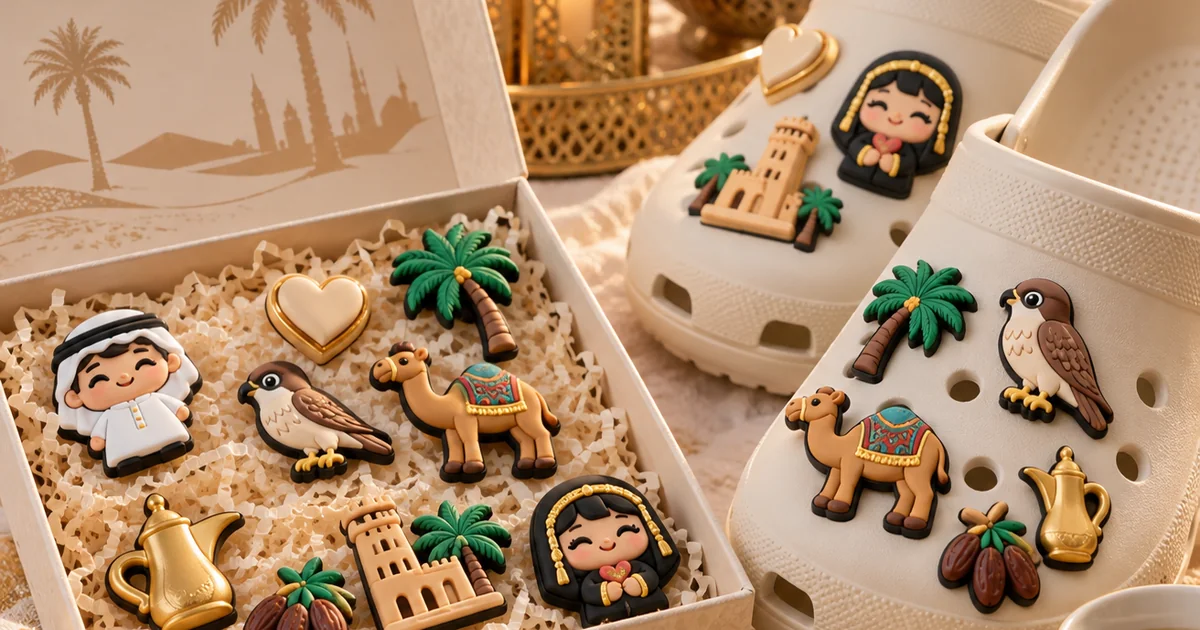
There is a version of the Gulf gifting season that treats it as a desert Christmas: ship the usual sparkle in gold wrapping and call it festive. It fails every year, for a reason the data makes plain. Google's Ramadan research across the region is explicit about what the season actually means — family, community and giving — and the buying that surges around Eid is an expression of those values, not a licence for novelty. A charm programme that respects that reading earns a reorder; one that cartoons it does not get a second meeting.
This guide covers the shape of the peak, the 2027 order window, and the motif discipline that keeps a Ramadan and Eid range on the right side of a religious culture. It is written for retail buyers planning a first or better Gulf programme.
1. The peak is real, and it is late-Ramadan
The numbers behind the season are unusually strong. Google and Visa's joint research on the United Arab Emirates and Saudi Arabia found discretionary-search interest growing at roughly ten percent, Visa card spend up seventeen percent in the UAE and eleven percent in Saudi, and interest in international ecommerce brands more than doubling through 2024. Into that rising base drops the seasonal spike: as Ramadan draws to a close, luxury apparel search interest climbs twenty-one percent in the UAE and forty-five percent in Saudi Arabia. Google's own Ramadan work confirms the behaviour — shopping activity strengthens in the approach to Eid, concentrated on gifting.
For a charm buyer, the read is structural. The demand peak is not scattered across the holy month; it concentrates at its end, on Eid gifting. Whatever the range must do — say gifting, survive a gift box, read as considered rather than cheap — it must do it in the final stretch, and the stock must be on shelves before the month begins.
2. Cross-border is the entry, and the two markets are not one
Two further findings shape the entry strategy. First, cross-border is a genuine channel here, not a rounding error: a fifth of Saudi online fashion spend already flows to international sellers, against five percent to purely local ones. International assortment is what Saudi shoppers are trained to expect. Second, the two flagship markets should be planned separately. Saudi Arabia's year is driven by national moments — the festivals, the September national day, the rhythm of pay-cycle retail — while the UAE runs a more cross-border, multi-population profile with a wider gifting audience. The same Ramadan range can serve both; the merchandising calendar and the gifting depth should not assume they are one market.
3. The 2027 window, worked backwards
Ramadan in 2027 is expected to begin in early February, with Eid al-Fitr falling in March — dates that shift each year and are confirmed nationally, so treat them as planning anchors rather than fixed days. The order logic is the standard one for a date-anchored gifting peak: wholesale watching begins in September and October of the year before, core orders land from November through January, and retail runs through the holy month into the Eid peak. Worked backwards from a February start, the design conversation is an autumn conversation — which is why the seasonal sourcing calendar matters more in this region than almost anywhere else: the peaks move every year and the plan has to move with them.
One structural note favours charm formats specifically: the gifting range that ships for Ramadan is not dated like a class-of charm. Moon phases, lanterns and geometry do not expire on a calendar day. Unsold Eid pieces clear into wedding-season gifting and everyday gifting stock — a shelf-life argument that year-dated seasonal ranges cannot make.
4. The motif discipline
The vocabulary that works is short, proven and — the word the research keeps returning to — restrained:
- Moon phases and crescents. The seasonal marker, abstract enough to sit on a bag charm without overstepping.
- Lanterns. The festive object of the season, readable at a glance, well suited to moulded depth.
- Geometry and star patterns. The region's strongest decorative language, and a natural fit for a process that builds separated colour zones.
- Gold accents on deep or pale bases. The metallic-and-jewellery feel the market reads as quality; a restrained gold-on-midnight or gold-on-ivory palette signals consideration better than saturation.
- Family and giving themes. Word plaques and keepsake formats that carry the season's actual meaning — the giving, not the getting.
The discipline on the other side of the line matters more than the list. Religious symbols are not cartooned, not merchandised as novelties, and not mixed into playful ranges. The safest architecture keeps the seasonal range entirely on the abstract vocabulary above — which is also, not coincidentally, the vocabulary that moulds beautifully in soft PVC at a 30 mm wearable size, with gold zones that survive as separate moulded colours rather than painted afterthoughts.
5. Quality signalling is part of the product
Gulf gifting is quality-led, and the research is blunt about it: this is a market where shoppers pay more for quality and finish, and where the gift's presentation carries meaning. For a charm programme that translates into three build decisions. The piece itself needs moulded depth and clean colour separation, because the range will be handled and compared, not just viewed. The format needs to arrive as a finished gift — a printed backing card, a box-ready set — because the card and the box are part of the gesture, not packaging afterthoughts. And colour decisions, gold zones especially, need confirming on physical colour cards, where metallic drift shows honestly; the craft base for all of this is covered in the custom sourcing guide.
6. The rest of the Gulf year
The two festivals are the anchor, not the whole calendar. Back-to-school runs as an intense weeks-long sprint rather than a long summer runway. A September national day gives Saudi Arabia a second national moment for colour-led, flag-palette editions — green and white, crest-free. And the region's Black Friday week shows deal-search interest spiking hard, which makes it a replenishment and gift-set mechanism for the ranges already built, not a discounting occasion that cheapens them. Buyers who add these three windows to the Eid peak get a four-beat year; Southeast Asia's two-calendar year, by contrast, is mapped separately.
7. What we build
Our charms are drawn for the drop-moulding process — moon, lantern, geometry and word-plaque formats in original artwork from our in-house studio, with moulding, colour matching, baking and UV printing done in-house and inspection before packing. Gifting programmes — Eid sets, family keepsake cards, national-moment colourways — run on that library every year. If you are planning a Gulf programme for 2027, tell us what the season needs to say — sales@mochicharms.com.