- Home
- Sourcing guides
- Private Label Charms: A Build Guide for Retail Brands
Private Label Charms: A Build Guide for Retail Brands
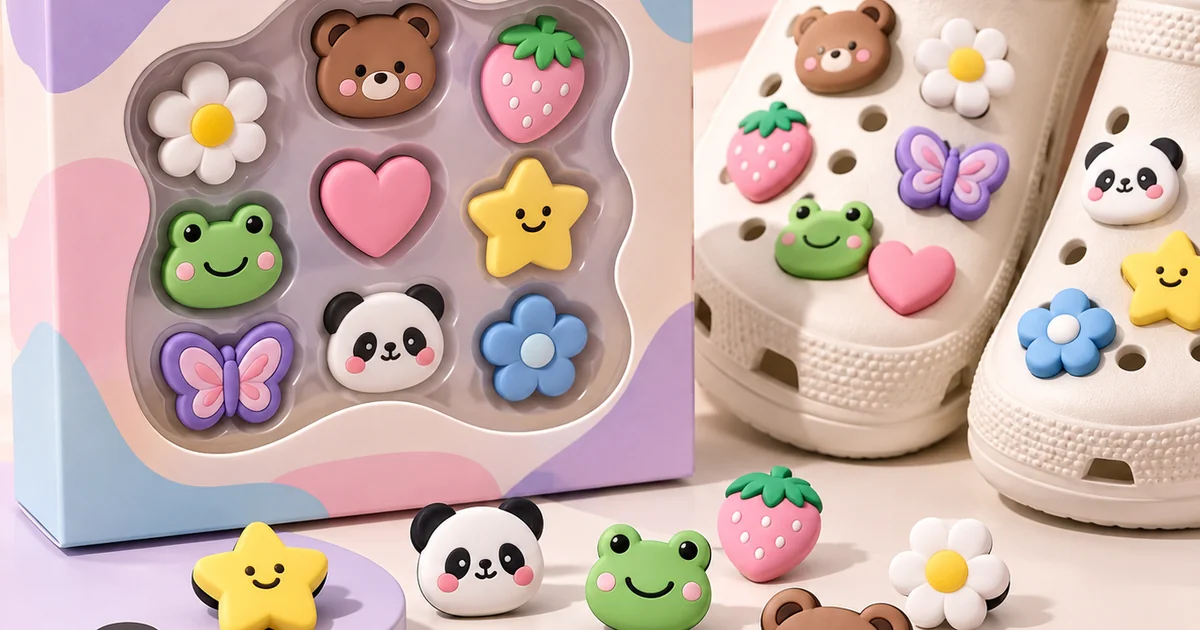
Every charm buyer asks about private label eventually, and most of the confusion starts right there — because "private label" means three different things in this trade, and quoting the wrong one produces wildly different lead times, tooling conversations and shelf outcomes. This guide sets the vocabulary first, then walks through the decisions that actually determine whether a house programme works: which surface you customise, how you structure the range, and the calendar you build all of it against.
1. Three levels of "yours"
- White label. You buy existing designs unbranded and sell them under your own tag. Fastest to stock, weakest to defend: the same goods sit on a dozen other rails, and the only differentiation left is your price ticket. In a category drifting toward identity, that is the wrong end to own.
- Private label. You take a working design library and make it yours through bounded decisions — house colours across a fixed core, word plaques in your voice, formats and backing cards built for your fixtures. The silhouettes are proven; the identity is exclusively yours. This is the level most buyers actually want once the vocabulary is clear.
- Full custom OEM. New artwork, new tooling, a design conversation measured in seasons. Right for a signature launch, heavy as a default — which is why programmes that start here usually shrink back to level two by the second meeting.
The practical advice: audit what you are actually asking for. If the answer is "our colours, our words, our cards", that is level two, and it is the strongest position in the middle of the market.
2. Why the middle level is winning now
Three market readings point the same way. First, the motive: Zalando's trend research across ten European cities puts self-expression and personalization at the core of the charm boom — shoppers treat the carrier as a canvas and the charm as the statement. A house programme is that motive, supplied at retail: the shopper who wants to say "this is me" buys it from the shop that already says "this is us". The European trend briefing covers the consumer side of that data.
Second, the collectible pull: in eBay's European recommerce research, 36 percent of surveyed consumers hunt unique or collectible pieces, and 56 percent say second-hand helps them express personal style. Curation is a trained habit — shoppers who assemble a considered vintage bag are the same shoppers who reward a charm wall with visible series rules. A private label range with a consistent colour story and a documented motif list reads as collectible; generic stock never does.
Third, the supply side: generic icon piles are the mature, crowded end of the category — the first to lose the shelf war. The differences that justify building a programme are quantifiable: personalisation, sets, cross-carrier formats, regional semantics, distinct craft. Every one of those is a level-two decision, not a level-three one.
3. The three surfaces you actually customise
A private label programme is not a redesign; it is a sequence of bounded decisions on three surfaces.
- Colour. The house palette applied across a fixed core of silhouettes — the single highest-leverage decision, because colour is what the rail reads from three metres away. The rule that protects it: colours are confirmed on physical colour cards, never screen-matched, because screens drift exactly where gift-with-purchase photography cannot afford it. Layered moulded colour zones keep the palette crisp through bag and pocket wear.
- Words. Word plaques are the most direct custom surface in the catalogue — a house motto, a city name, a seasonal festival word. Moulded lettering carries depth you can feel and legibility that survives crowd wear, checked and approved on cured curved pieces rather than flat renders. The gate that must never slip: word requests are reviewed for rights before any moulding starts, the same screening that protects the rest of the catalogue.
- Format. Sets versus singles, and the backing card as your brand surface — the printed card carries the house identity while the charm itself stays clean of anything requiring approvals. Cross-carrier fitting belongs at sampling: the same series can serve shoe, bag, keychain and zipper positions, and the fitting is spec'd once, up front, not retrofitted after the order.
4. Structuring the range
A workable programme has a shape: one hero, a core of three to five, one or two tests. The hero carries the launch visual; the core is the reorder engine; the tests are where the next season's winners come from — and where the duds die cheaply. Around that shape, two disciplines matter more than any single design choice.
Library depth. A private label programme lives or dies on refills. When the core sells through, the answer should be "more from the library in the house palette", not "back to the drawing board". That is why the level-two route starts from a working series — twenty designs deep, say — rather than a handful of sketched icons.
One colour story per drop. A range reads as a family in photographs or it does not read at all. The drop-level decision is a palette, not a set of individual picks; shoppers collecting a look will only see the system if the system is visible on the rail.
Cohort and calendar editions are where the structure pays off hardest — a class-of graduation programme is a worked example, and the graduation sourcing guide walks that case end to end.
5. The calendar you build against
Wholesale rhythm runs months ahead of the retail moment: Valentine browsing starts the prior October, Christmas core orders land August through October, and spring programmes are planned against summer peaks. A private label buy adds one round to that rhythm — the colour-card and cured-sample approvals — so the practical rule is to start one buying window earlier than an equivalent catalog order.
Split the programme while you plan it: seasonal capsules follow the calendar and exit clean, while the evergreen identity wall reorders on sell-through rather than on dates, because identity charms do not expire. The seasonal sourcing calendar maps the windows; the private label decision is only which side of that split each design lives on.
6. Red flags, briefly
- A "private label programme" that amounts to your logo on one charm in six colours.
- Colour approvals handled over screen shares, colour cards never mentioned.
- Word requests accepted for moulding with no rights screening step.
- A supplier who cannot show a series they actually designed — only goods they catalogued.
7. What we build
Our series are drawn for the drop-moulding process at a 30 mm wearable size — word and message plaques, real-breed animals, occupation icons and colour-led series, all original artwork from our in-house studio, with moulding, colour matching, baking and UV printing done in-house and inspection before packing. Private label programmes run on colour, words and formats across that library. If you are planning a house programme, tell us the wall you want to build — sales@mochicharms.com.