- Home
- Sourcing guides
- How to Source Custom PVC Shoe Charms: A Buyer's Guide
How to Source Custom PVC Shoe Charms: A Buyer's Guide
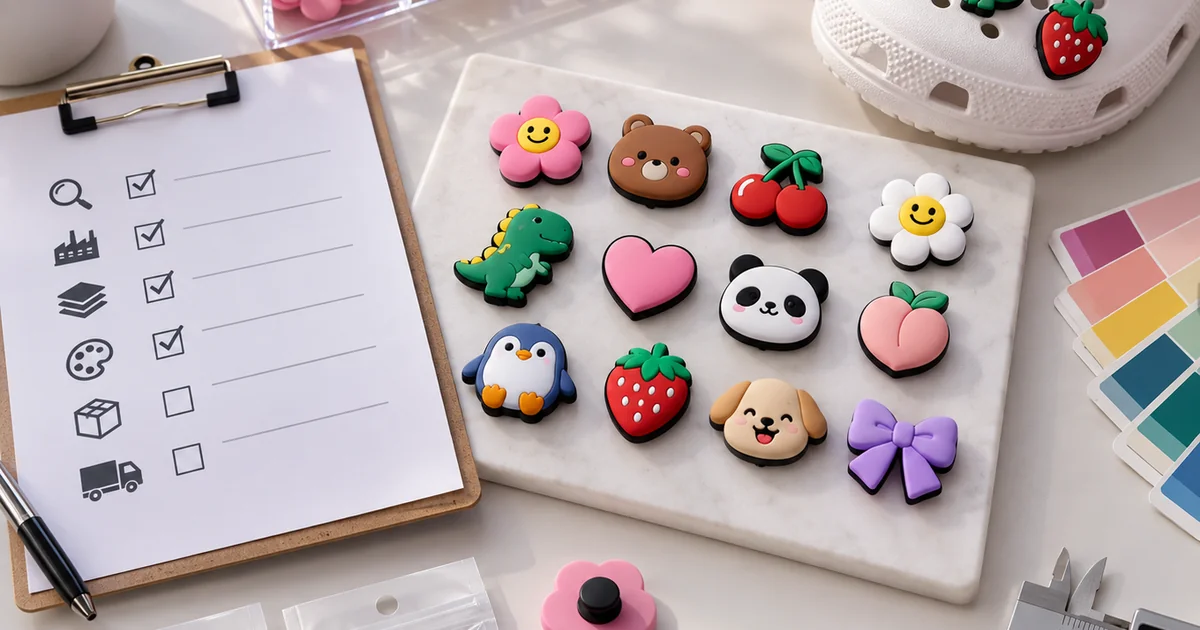
Shoe charms look like the simplest product in a merch catalogue — a 30 mm blob of soft PVC on a strap. Then you try to buy 5,000 of them, and the questions start. How many colours per charm? Does the glow layer survive a washing machine? Who owns the artwork if the factory drew it? This guide walks through the decisions that separate a smooth charm programme from a disappointing one, in the order you will actually meet them.
1. Know the process before you ask for quotes
Most custom shoe charms are made by drop moulding (also called PVC dispensing): liquid PVC is dispensed layer by layer into a mould, then baked to cure. Each colour is a separate layer with its own dispensing pass, which is why colour count drives cost more than size does. Fine details that a printer would handle easily — tiny text, gradients, photographic shading — are better added as UV-printed accents on top of the moulded body, or simplified into bolder shapes.
A workshop that designs for its own process will already draw artwork with rounded edges, generous colour zones and readable silhouettes. That single habit predicts fewer sampling rounds than almost anything else you can check. The same habit travels across carriers: bag-charm programmes in Europe are being specced the same way right now — our European bag-charm trend briefing shows what buyers there are asking for.
What to ask any factory: Do you mould in-house or outsource? Is UV printing done on site? Can you show a design drawn specifically for drop moulding next to the finished sample?
2. Write a spec sheet that gets accurate quotes
Vague briefs produce padded quotes. A quote-ready spec for one charm SKU:
- Size and weight — e.g. 30 mm wearable size; state the maximum thickness too, since chunky silhouettes affect mould count.
- Colour count — number of moulded colours plus any UV-printed accents, with Pantone references where the shade matters.
- Material finish — soft PVC; matte or glossy surface; optional effects such as glow-in-the-dark or pearlescent pigment.
- Attachment — the fitting that holds the charm onto a clog strap, lanyard, zipper pull or keyring.
- Packaging — polybag, backing card, gift box or blind-bag format; whether the card is printed and assembled at the factory.
Send the same spec to every factory you quote. The differences in their answers are information.
3. Treat sampling as a process, not a formality
A charm sample exists to answer three questions: colour, edges and adhesion. Check the sample in the light conditions your customers will see it — retail lighting, phone screens, a shop window at noon. Rub the printed accents with a finger over a dry cloth; check whether painted zones chip at the corners where moulding meets trimming. Look at the edges: drop-moulded PVC should feel rounded and blunt, with no sharp flash lines left from the mould seam.
Colour matching deserves a note of its own. Soft PVC colours shift slightly between a flat colour chip and a cured, glossy, curved surface. Ask for a physical colour reference rather than approving from a screen, and expect one revision round to be normal.
4. Artwork, and who owns it
There are two ways to end up with charm artwork: bring your own, or use the factory's original designs. Both are workable — but the middle path, quietly borrowing a licensed character or a recognisable brand mark, is where programmes get into trouble. Popular culture references, sports logos, school crests and cartoon lookalikes all carry takedown and customs risk, and a factory that shrugs at this question is telling you something.
If you commission designs, agree in writing who holds the artwork and whether the factory may show it in their portfolio. If you buy from the factory's existing series, ask for the design story: an original themed series with consistent rules — a shared silhouette grammar, a set number of colours, a documented motif list — is evidence of a design capability you can reuse season after season, not just a one-off SKU. The graduation season is a clean worked example of these rights rules in action — our graduation charms sourcing guide walks it end to end.
5. Where the quality actually gets decided
Charm quality is mostly decided in the unglamorous steps: mould maintenance between runs, baking time and temperature, trimming consistency, and inspection before packing. A practical shortcut is to ask how inspection works — at what stage, against what checklist, and what happens to rejected pieces. Factories with a real answer will describe stages; factories with a vague one will describe attitudes.
For retail programmes, also ask about packing: whether mixed-SKU sets are collated by machine or by hand, and how the backing card is attached so cards do not arrive curled or torn.
6. Plan the calendar, not just the product
Seasonal charms reward early planning more than most merch, because buyers start searching months before the holiday — wholesale search interest for Valentine's Day picks up from October, Easter from December, and Halloween and Christmas from May, according to Faire's wholesale buying calendar. Peak months are for reorders of proven designs; first orders of original series belong in the earlier window, when there is still time to sample, revise and ship by sea. For the month-by-month view, see the 2027 seasonal sourcing calendar; for the two windows that are closing right now, see the Halloween & Christmas quick-turn decision piece.
7. Red flags, briefly
- Quotes that arrive without a single question about attachment or packaging.
- "Any design is fine" — including the ones that legally aren't.
- Samples that only look right in one photo angle.
- No physical colour reference offered, ever.
- Moulding outsourced so far away the factory cannot check a batch mid-run.
None of these are automatically disqualifying. All of them are worth one direct question before you commit.
8. Working with a workshop that designs in-house
Our own approach at MOCHI CHARMS is built around original themed series — cross-section food, night-sky animals with glow and pearlescent accents, occupation characters and a mix-and-match identity system — all drawn for the drop-moulding process at a 30 mm wearable size, with moulding, colour matching, baking and UV printing done in-house and inspection before packing. If you are planning a charm programme, from a single custom design to a multi-series retail assortment, tell us what you are trying to launch and we will start with artwork, colourways and samples.
Questions or artwork to share? Write to sales@mochicharms.com — or save this guide for your next sourcing round.