- Home
- Sourcing guides
- Halloween & Christmas 2026: Quick-Turn or Wait?
Halloween & Christmas 2026: Quick-Turn or Wait?
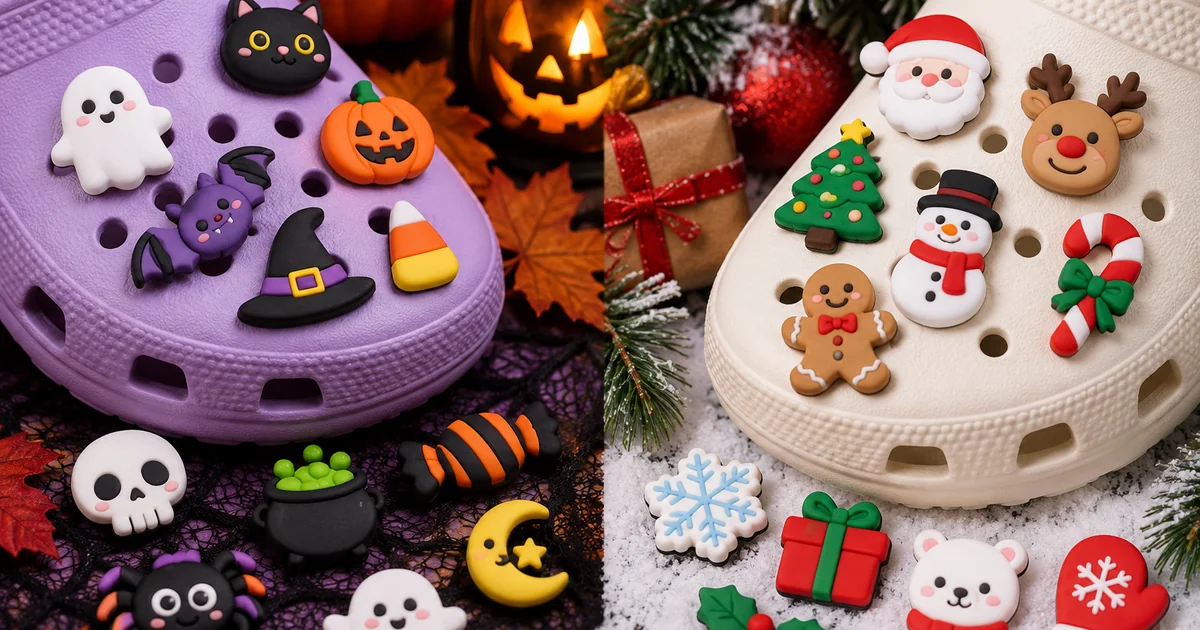
The two biggest charm holidays of the year are both in closed or closing windows for full original programmes. That is not a counsel of despair — it is a two-track decision that seasoned buyers make every year: run a disciplined quick-turn capsule for 2026, and put the real original-series effort into 2027, where the decision window is open right now. This piece breaks down when each track makes sense, what a quick-turn capsule actually contains, and how to think about 2027 before the 2026 rush absorbs your whole team.
For the month-by-month view across all of 2027, see the 2027 seasonal sourcing calendar.
1. Why the 2026 windows closed early
Wholesale search interest for both Halloween and Christmas starts building in May, per Faire's wholesale buying calendar — buyers are not waiting for autumn to place holiday orders. Measured in late August 2026, roughly ten weeks remained to Halloween and eighteen to Christmas. For an original charm programme — new artwork, new tooling, sampling rounds, sea freight — that is not a schedule; it is a gamble.
So the honest position for most buyers: a full original Halloween or Christmas 2026 series is no longer realistic, and pretending otherwise produces rushed artwork, air-freight premiums and shelf risk. The buyers who look calm in October are the ones who decided in spring.
2. The quick-turn capsule: what it is, and what it is not
A quick-turn capsule is a tightly scoped 4–6 design set built on existing tooling: colourway changes, existing moulds, proven motifs — original artwork, but original in a narrow lane. It exists to catch the late window without betting the season on it.
What belongs in one:
- Winter-proof, holiday-agnostic motifs. Snowflakes over Santa; stars and moons over licensed characters. A snowflake sells from November through February, then returns next year; a dated holiday icon clears or dies by December 25.
- Colour-led reskins of proven shapes. A doughnut or candy-bag silhouette in a winter palette reuses proven moulds while still reading seasonal on the shelf.
- Formats that photograph as a family. Small sets on one printed backing card — the stocking-stuffer format lives or dies on shelf photo, not piece count.
What it is not: a full original series squeezed into half the time, a promise to "rush the artwork", or a bet on one hero licensed character. The red-sea warning applies twice over in late windows — generic Halloween and Christmas icon collages are the most crowded shelf in the category, and late buyers default to them precisely because there is no time to differentiate.
Two process notes separate a workable capsule from a stressful one. First, lettering and fine motifs need approval on cured, curved pieces rather than flat screen renders — a plaque that reads cleanly on screen can blur at the mould seam, and that discovery belongs at sampling, not at production. Second, keep the colour story narrow and physical: colour judgements made against a screen drift, so match against physical colour cards and freeze the palette before tooling starts. A capsule scoped this way keeps its originality in artwork and colour judgement — which is exactly what a late window can still absorb.
3. Christmas 2026 by country, not "Europe"
If you do run a Q4 capsule, sequence it by country rather than treating Europe as one market. Wholesale Christmas search peaks differ by market — Germany in September, the UK in October, France in November — so one blanket "European November drop" misses two of the three peaks. Germany should be on the water before the UK conversation starts.
The same country-first logic runs past Christmas. European school calendars start on different dates in different countries — official EU data shows start weeks spread across late August and September — so any charm format leaning on a back-to-school story inherits the same sequencing problem. And Black Friday, November 27 in 2026, sits late enough to run into the French Christmas search peak: treat it as a merchandising moment for gift-ready sets and price tiers rather than a theme that deserves its own artwork.
4. The 2027 track: already open
Here is the part most buyers miss: the 2027 decision window opens while 2026 is still shipping. Wholesale search interest for Valentine's Day starts building in October, and Easter follows from December. That means the artwork conversations for Valentine 2027 and Easter 2027 belong in the next few weeks, not after the new year.
The 2027 candidates worth committing original artwork to, in the order their windows open:
- Valentine 2027 — window opens first; see the Valentine 2027 charm sourcing guide.
- Easter and spring 2027 — Easter falls on March 28, 2027; see the Easter 2027 charm program trends piece.
- Lunar New Year and Ramadan–Eid programmes — earlier or floating windows; decide early whether they are in scope.
- Mother's Day 2027 — search starts in January; name, initial and birth-flower motifs carry the gifting angle.
- Summer and vacation 2027 — vacation search also builds from January, so one spring design sprint can feed two seasons.
- Back-to-school 2027 — split by school calendar: Singapore starts in January, the Philippines in June, much of Indonesia in July.
A practical split that works: one person owns the 2026 quick-turn capsule, another owns 2027 original programmes. The failure mode is one team doing both sequentially — the capsule eats November, and 2027 starts two months late.
5. Red flags, briefly
- A supplier who promises a full original holiday series "in time" from a standing start in September or October.
- A quick-turn proposal that quietly includes new tooling.
- A 2027 plan that starts after Chinese New Year.
- Christmas gifting programmes planned as one pan-European drop.
6. What we build
Our seasonal series are drawn for the drop-moulding process at a 30 mm wearable size — a Snowflake series that carries winter without a holiday licence, food and sweet series that reskin cleanly into winter palettes, and themed series across animals, occupations and identity, all original artwork from our in-house studio, with moulding, colour matching, baking and UV printing done in-house and inspection before packing. If you are deciding between a 2026 capsule and a 2027 original programme, tell us both dates you are working to — sales@mochicharms.com.